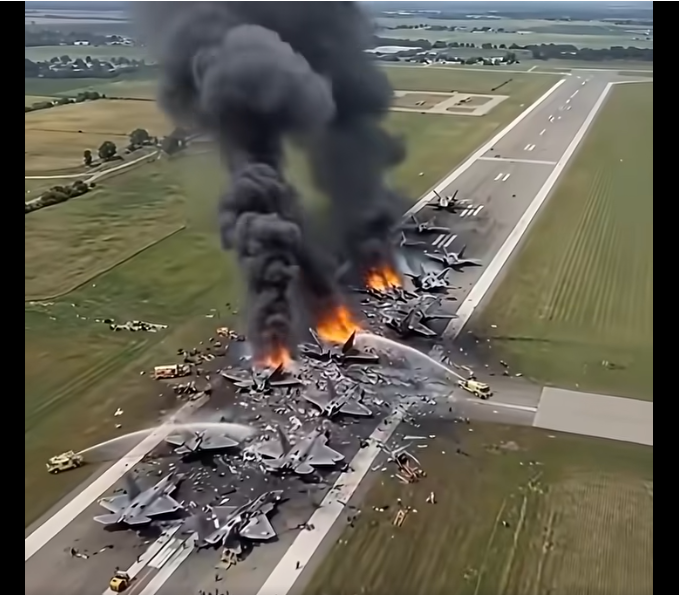
The devastating consequences of a massive military aviation disaster are captured in vivid detail from an aerial perspective over an airfield runway environment. Multiple advanced fighter jets are seen completely destroyed and scattered haphazardly across the main concrete runway after what appears to be a catastrophic collision or sudden ground incident. Raging fires consume several of these multi-million dollar stealth aircraft, sending massive plumes of thick, pitch-black smoke billowing high into the clear sky. The intense heat from the burning aviation fuel creates a highly volatile situation as emergency crews rush to contain the spreading inferno. Debris from shattered wings, fuselages, and tail sections is strewn across hundreds of yards of the runway, indicating the violent nature of the impact. Specialized airfield firefighting vehicles have arrived on the scene and are actively deploying high-pressure water cannons to suppress the active flames. Thick streams of white foam and water are sprayed directly onto the twisted metal of the burning jets in a desperate attempt to prevent secondary explosions. Emergency response teams can be seen coordinating their efforts on the ground, navigating carefully around the dangerous wreckage and scattered armaments. The surrounding grassy fields remain untouched by the blast, creating a sharp contrast between the serene countryside and the chaotic destruction on the tarmac. This shocking video footage provides a rare and sobering look into the immense risks associated with high-speed military aviation maneuvers and tactical airfield operations. Military investigators will likely analyze this exact aerial imagery to determine the sequence of events that led to such a widespread and costly accident. The specific design of the destroyed aircraft closely resembles modern fifth-generation stealth fighters, highlighting the significant national security and economic loss of this event. Several intact support vehicles and emergency vans are parked at a safe distance along the taxiway to establish a command center for the rescue personnel. The sheer scale of the wreckage suggests that multiple aircraft were involved simultaneously, possibly during a formation takeoff, landing sequence, or sudden ground incident. As the firefighters continue their relentless assault on the flames, the black smoke slowly begins to thin, revealing the true extent of the structural damage to the airframes. The melted aluminum and charred titanium components of the aircraft illustrate the extreme temperatures reached during the peak of the aviation fuel fire. Online audiences are often captivated by these intense disaster scenes because they showcase the unpredictable dangers faced by military personnel during training or deployment. Search engine optimization for topics regarding military accidents relies heavily on targeted phrases such as fighter jet crash, airfield emergency response, and aviation disaster footage. Providing accurate, highly detailed descriptions of these events helps viewers understand the logistical complexities of managing an active airfield crisis. The layout of the runway markings remains clearly visible beneath the debris, serving as a grim reference point for mapping the trajectory of the crash. Airfield safety protocols dictate that all operations must be immediately halted during an incident of this magnitude to allow first responders unhindered access. The coordination between the different firefighting units on the ground reflects rigorous training and a well-rehearsed emergency action plan. As the water cannons suppress the main body of the fire, smaller localized hotspots continue to smolder within the internal compartments of the jets. The video serves as a stark reminder of the volatile nature of military hardware and the constant vigilance required to maintain operational safety. Military aviation experts will scrutinize the wreckage pattern to rule out mechanical failure, pilot error, or external environmental factors. The financial impact of losing an entire fleet of advanced combat aircraft on a single runway is immense and will be felt across the entire defense sector. Salvage crews will eventually face the daunting task of clearing the heavy debris and hazardous materials from the tarmac before operations can resume. The environmental impact of burning jet fuel and toxic composite materials must also be carefully managed by specialized hazmat teams on-site. In the distance, the quiet rural landscape stretches out toward the horizon, seemingly detached from the high-stakes drama unfolding on the runway. The aerial perspective allows viewers to appreciate the vast footprint of the destruction, which spans across several intersecting taxiways. Every second of the footage highlights the bravery and efficiency of the first responders who risk their lives near explosive military materials. Public interest in military aviation safety consistently drives significant digital engagement, making detailed visual documentation highly valuable for news reporting. The stark contrast between the bright yellow fire engines and the dark gray camouflage of the ruined jets creates a powerful visual narrative. As the emergency operation progresses, additional support personnel arrive to secure the perimeter and prevent unauthorized access to the classified technology. The loss of these strategic defense assets will undoubtedly trigger a comprehensive safety review across the entire military aviation branch. Many online discussions surrounding these videos focus on the survivability of the aircrews and the effectiveness of modern ejection seats or ground escape systems. The structural integrity of the runway itself may be severely compromised due to the intense thermal stress caused by the burning wreckage. Specialized scanning equipment will be used post-incident to check for micro-fractures in the concrete surface before any aircraft are permitted to land again. The video ends with the firefighting teams still actively battling the remnants of the fire, emphasizing the prolonged nature of disaster recovery. Analyzing these real-world scenarios provides invaluable data that can be used to improve the design of future airfield safety systems and response vehicles. The precise alignment of the aircraft wreckage suggests a chain-reaction event where one initial impact quickly spread to adjacent parked or moving assets. This level of clustered destruction is highly unusual for a standard military base, prompting deeper questions about the operational conditions at the time. The visual documentation of the event remains a crucial tool for transparent reporting and accountability within the defense infrastructure. Viewers can see the water foam blanketing the area, which acts as a vapor barrier to suppress explosive gases emanating from the ruptured fuel tanks. The meticulous nature of the emergency response ensures that every potential hazard is systematically neutralized before investigators approach the scene. As the initial shock subsides, the focus transitions from immediate life-saving and firefighting to long-term investigation and site remediation. The high-definition aerial footage captures the grim reality of military operational risks with undeniable clarity and impact. Each piece of scattered metal represents a critical clue that will help aviation safety boards piece together the final moments of these high-performance machines. The international defense community closely monitors these incidents to learn vital lessons regarding fleet management and airfield vulnerability. Ultimately, this intense and tragic visual record underscores the immense sacrifices and constant dangers inherent in the defense of a nation.