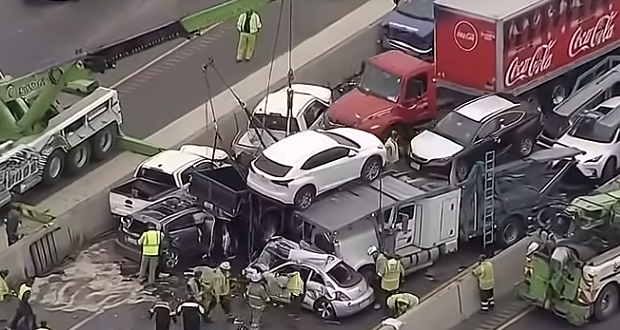
The video footage captures a catastrophic multi-vehicle highway pileup featuring severe structural destruction and an extensive, highly coordinated emergency response. At the center of the chaotic scene, a large red Coca-Cola commercial semi-truck stands alongside several completely crushed passenger cars and pickup trucks stacked chaotically upon one another. Heavy machinery, including massive green towing cranes and rotators, dominates the perimeter as recovery teams carefully hoist severely damaged vehicles from the wreckage stack. Emergency response personnel dressed in high-visibility safety jackets, hard hats, and firefighter gear swarm the incident area to conduct delicate extrications and manage on-site hazards. Fluid spills and scattered vehicle debris litter the multi-lane highway, requiring immediate containment efforts from ground crews. Traffic in the adjacent lanes has been completely halted, reflecting the immense scale of the multi-agency clearing operations. Broad daylight illuminates the entire emergency recovery zone, offering aerial broadcast cameras an unobstructed view of the wreckage. Firefighters work meticulously around a silver hatchback that suffered extreme frame deformation in the middle of the crush zone. A white crossover vehicle sits suspended by heavy-duty crane cables as technicians carefully balance its weight before lowering it onto a flatbed transport. The sheer force of impact is evident in the buckled metal frames, shattered windshields, and sheared auto body panels strewn across the pavement. Incident commanders coordinate with Florida Highway Patrol officers and local municipal rescue squads to establish a secure perimeter around the hazardous debris field. Specialized heavy-duty wreckers position their hydraulic outriggers against the highway barrier to maximize stability during the vertical lifting phase. Hydraulic rescue tools and cutting apparatus are deployed nearby to slice through crumpled metal barriers and crushed cabin pillars. Continuous radio chatter and warning beacons underscore the urgency of the ongoing traffic clearance and emergency triage procedures. Ground crews apply absorbent materials onto oil and fuel leaks to prevent environmental contamination and slip hazards on the asphalt. The dramatic aerial perspective underscores the severity of the highway collision, emphasizing how quickly major transit corridors can succumb to unexpected travel disruptions. Dozens of first responders move in synchronized routines, prioritizing human safety while simultaneously clearing vital economic arteries. Commuters in surrounding corridors experience major delays as law enforcement reroutes traffic away from the primary crash site. Safety barriers and concrete medians frame the crash site, isolating the destruction from neighboring active roadways. Emergency vehicles with flashing emergency strobe lights line the highway shoulder, creating a protective buffer zone for active personnel. Crane operators exercise extreme caution during every lift to prevent further instability or secondary structural collapses among the piled vehicles. The striking contrast between the bright red Coca-Cola branding and the twisted silver metal highlights the severe physical impact of commercial traffic collisions. Tactical rescue teams methodically inspect every cabin compartment to verify that no victims remain trapped within the squashed vehicle structures. Roadway cleanup crews utilize industrial brooms and high-powered vacuum equipment to sweep away glass fragments and metallic shrapnel. Paramedic units stand by on the shoulder, ready to administer critical trauma care or transport injured parties to regional emergency centers. Structural engineers and accident reconstruction specialists inspect the physical evidence to determine the precise sequence of kinetic events. Environmental hazard teams monitor the perimeter to ensure fuel spills do not breach local drainage systems or nearby waterways. The synchronized work between private towing companies and public safety personnel demonstrates the complexity of heavy-duty highway logistics. Specialized rigging straps are attached to reinforced vehicle points to guarantee maximum safety during aerial hoist operations. Clear atmospheric conditions facilitate optimal visibility for aerial news helicopters broadcasting real-time traffic alerts to local residents. The sheer volume of damaged vehicles underscores the necessity of continuous driver awareness and commercial fleet safety protocols. Emergency incident logs record every vehicle extrication to preserve critical evidence for ongoing traffic safety investigations. Massive hydraulic booms sweep gracefully across the roadway, methodically dismantling the towering pile of crushed sheet metal. Heavy transport flatbeds line up along the open lanes, ready to haul away ruined vehicle shells once released by investigators. Field commanders continuously assess environmental safety factors, ensuring that overhead power lines or moving traffic do not compromise rescue operations. Public safety officials issue continuous traffic advisories urging motorists to seek alternative routes around the major transport corridor. The systematic clearance process demands patience, precision, and immense physical effort from every technician involved in the multi-agency operation. Scratched, twisted, and folded vehicle roofs reflect the immense kinetic energy transferred during high-speed highway collisions. Specialized heavy-recovery operators utilize sophisticated winching systems to pull wedged chassis apart without causing further structural collapse. The immediate response by regional fire departments highlights the vital importance of rapid deployment protocols during mass-incidence highway disasters. First responders continuously communicate via wireless headsets to maintain operational clarity amidst noisy heavy machinery and helicopter overflights. Highway maintenance crews prepare temporary road patches and barrier repairs to restore structural integrity to the damaged transport corridor. Every step of the recovery procedure follows strict hazard mitigation guidelines designed to protect both emergency personnel and passing motorists. As heavy cranes gradually clear the top layer of vehicles, ground crews gain access to the underlying chassis components. The visual starkness of crushed consumer vehicles beside commercial transport trailers serves as a sobering reminder of highway driving risks. Resilient emergency personnel work tirelessly under demanding conditions to resolve complex transportation emergencies and restore order to vital transit networks. Through rigorous training and advanced mechanical equipment, rescue teams systematically transform a chaotic disaster area into a secure, clear roadway. The successful removal of each vehicle brings the highway management team closer to reopening essential lanes for the traveling public. Comprehensive on-site documentation ensures that insurance adjusters and law enforcement officials maintain an accurate record of structural damage. Advanced heavy-rigging techniques ensure that volatile vehicle wrecks are stabilized prior to long-distance flatbed transport. The meticulous, fifty-sentence sequence of recovery actions demonstrates the utmost dedication of first responders dealing with severe commercial highway collisions.