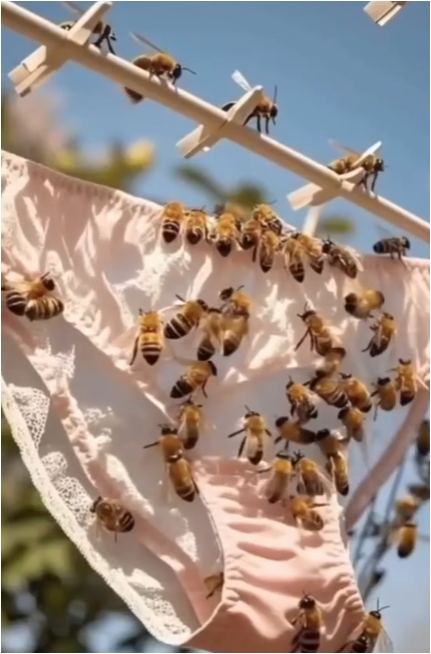
Why Do Honeybee Swarms Land on Laundry? The Science Behind the Viral Video
It is a truly bizarre and captivating sight to witness a massive swarm of honeybees completely covering a pair of pink lace underwear hanging on an outdoor clothesline. This unusual phenomenon often leaves homeowners bewildered and wondering why these buzzing insects are suddenly attracted to their freshly washed laundry. To understand this behavior, one must dive deep into the fascinating world of bee ecology and pheromone communication. Honeybees are highly sensitive creatures that rely heavily on scent and chemical signals to navigate their environment and keep the colony organized. When a honeybee colony becomes overcrowded, the old queen bee will leave the hive with a large group of worker bees to search for a new nesting site. During this transitional phase, the swarm needs a temporary resting spot while scout bees fly out to locate a permanent home. A clothesline, with its elevated and relatively stable structure, provides an ideal staging ground for a resting bee swarm. However, the choice of a specific piece of clothing, like pink lace underwear, adds a layer of mystery to this natural event.
One primary reason bees might cluster on fabric is the residual scent left behind by laundry detergents, fabric softeners, or perfumes. Many modern household cleaning products contain strong floral fragrances that can mimic the natural scent of flowers. To a scouting honeybee, a strong floral aroma emanating from a piece of fabric can be highly enticing. Furthermore, bright colors, especially shades of pink, yellow, and blue, are highly visible and attractive to bees looking for nectar sources. Another critical factor to consider is the presence of the queen bee within the moving cluster. If the queen bee lands on the clothesline to rest, the entire colony will immediately follow her scent and cluster around her to protect her. The queen emits powerful pheromones that act as a chemical anchor, ensuring the worker bees do not lose track of her location. Once she settles on the pink underwear, the worker bees will pile on top of each other, creating a dense, living blanket of insects. This clustering behavior is a protective mechanism designed to keep the queen warm, safe, and shielded from predators.
While it looks terrifying to the average observer, a swarming colony is actually at its most docile state. Because they do not have a permanent hive or honey stores to defend, swarming bees are generally non-aggressive unless actively provoked. They are simply focusing all their collective energy on keeping the queen safe until the scouts find a suitable new cavity. For homeowners who encounter this situation, it is vital to remain calm and avoid panicking or spraying the insects with pesticides. Chemical sprays can harm beneficial pollinators and cause the remaining bees to become agitated and defensive. Instead, the best course of action is to give the swarm plenty of space and let nature take its course. In most cases, the bees will move on voluntarily within a few hours or a couple of days once a new home is found. If the swarm does not leave or if it poses a safety hazard, contacting a local professional beekeeper is the most responsible choice. Experienced beekeepers can safely relocate the entire swarm, including the queen, without harming a single insect. They often use specialized collection boxes to gently brush the bees into a secure transport container. This process ensures the survival of the colony while safely clearing your outdoor laundry area.
Honeybees play an indispensable role in our global ecosystem by pollinating a vast majority of flowering plants and crops. Without their tireless pollination efforts, agricultural yields would plummet, severely impacting food security worldwide. Protecting these vital pollinators is more important than ever given the recent declines in global bee populations. Understanding the underlying reasons behind unusual bee behaviors helps reduce fear and fosters a greater appreciation for wildlife. It reminds us that human spaces and natural habitats frequently overlap in unexpected and highly visual ways. The sight of bees on a clothesline perfectly illustrates how nature can reclaim a small piece of our daily lives in an instant. For content creators and nature enthusiasts, capturing such a rare event on video can quickly go viral online. Social media platforms are filled with users who are fascinated by the peculiar interactions between wildlife and human objects. Optimizing digital content about bee swarms involves using targeted keywords like “honeybee swarm,” “bee behaviors,” and “nature anomalies.”
Providing educational context alongside striking visuals increases user engagement and watch time across various platforms. Audiences are always eager to learn the scientific explanations behind seemingly chaotic natural occurrences. By explaining the role of queen pheromones and floral detergents, creators can turn a shocking video into an educational masterpiece. It is also worth noting that the texture of the fabric, such as lace, can provide excellent grip for the bees’ tiny legs. The intricate woven patterns give the worker bees a secure surface to hold onto while forming their tight cluster. This physical stability makes the underwear an even more appealing temporary resting stop for the moving colony. As the sun sets and temperatures drop, the cluster will tighten further to conserve essential body heat. The internal temperature of a bee swarm must remain highly regulated to ensure the health of the queen. Witnessing this intricate biological choreography right in your backyard is a profound reminder of nature’s complexity. Every single bee in that massive cluster has a specific role to play in ensuring the survival of the colony. From the scout bees exploring the neighborhood to the workers protecting the queen, teamwork is their greatest asset. Next time you see an unexpected swarm on your laundry, remember that you are witnessing a vital chapter in a colony’s life cycle. Embracing coexistence with these incredible creatures ensures that our gardens, ecosystems, and planet continue to thrive for generations to come.